Posts

Bible Study for Youth: Acts 8-13

Image
Well, I didn't get back to posting our Bible Studies like I had planned.  We've had some great ones, though, and I hope to get some more posted soon.  ["Soon", meaning, "no one really knows when, but it will happen one of these days".  ;-) ]  Here is a continuation of Acts. Chapter 8 1) Who was the magician in Samaria, ans how did he react to Phillip's preaching? 2) Scripture says that, although the Samaritan converts had been baptized, the Holy Spirit had not yet fallen upon them. How did they receive the Holy Spirit, and by whom? 2a) Can you think of a Sacrament we have today, which is given after Baptism, where the Holy Spirit strengthens us to go out and bring the Gospel to others? 3) What did the magician try to do when he saw this? 4) How did Peter react? (Quote him in verse 20.) 5) When Philip asks the eunuch if he understands what he is reading, what is the eunoch's reply? 5a) Was the eunoch an educated person? (See ve...
Where is Purgatory in the Bible?

Image
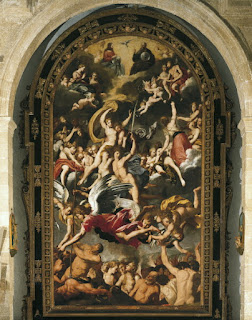
The question of purgatory is fairly common among inquiring non-Catholics and Catholic Christians alike. It can also be one of the most misunderstood. Some of the more common questions centered around the topic go like this: 1) Where is Purgatory in the Bible? I don't see it anywhere in the Scriptures. 2) Isn't it just a man-made doctrine for those who want to make a way for sinful people to get to heaven, bypassing the work of the Cross? 3) Is it supposed to be a second chance at heaven for people could not make it the first time around? 4) If we can add to the work of Christ, by paying for "some" of our sins in purgatory, then why can we not pay for all of them, eventually, in hell, and at some future point in eternity, escape hell? In order to answer the first question, I need to answer the third. Because what Purgatory is *not*, is certainly not in the Bible. But what it *is* is there as clear as day. And if you are only looking at what Purgat...

Is Ben Shapiro an Extreme, Judgmental Hypocrite?

I'll be perfectly honest. Until yesterday I didn't even know who Ben Shapiro was. Of course, I also don't watch television, listen to the radio very much, and I am married with 5 children. So, I don't know who a lot of people are. And in reality, I still don't know much about him, except for the tidbits that people have shown me in the past couple days. Here's what I DO know. Based on the little that was given to me, he has not said anything extreme, judgmental, or hypocritical enough for people to call him such. I moderate a couple FB pages, and one of the administrators of one of those pages posted a 4-minute video of Mr. Shapiro defending a baby's right to life. LINK to original VIDEO source No sooner that it was posted did people start rebuking his message. And it wasn't just pro-abortion folks doing so. It was pro-life Catholics. So, I decided I had better watch the video and find out what he said that had them in an uproar. After wat...

Coming Home to Holy Eucharist: Rob's Testimony

Image
The most powerful witness to a Christian's faith is his/her personal testimony. Personal testimony is probably the most effective way to evangelize...to bring Christ to others. Rob's testimony is one of many I have heard, and he is enthusiastic about sharing it. So much so, in fact, that he requested I use his real name in this post. Rob Gwisdala was born to a Catholic father and a Protestant mother in a time when the Church had started to focus so heavily on ecumenism that it practically forgot about catechesis. Education of the faith, and preparation for the Sacraments, after all, is primarily the role of parents. But in an age when the Church was offering these faith formation classes to young children, it forgot to emphasize to parents the primary importance of teaching the faith at home. Parents figured the Church would take care of it, and the Church assumed parents were doing what parents were supposed to be doing...and by the 1990's, droves of young Catholic adult...

Bible Study for Youth: Acts 1-7

Image
I started a list of Bible questions for my 11-year old in order to foster better comprehension and encourage more careful attention to details while reading the Bible. We started in Acts and stuck to about 2 chapters per quiz; but if anyone wants to borrow these, feel free to break or lump as you like, and get even more detailed if you wish. I hope you find these as useful as we have! I will be adding more "Bible Study for Youth" posts over the course of time (as we do them), so check in periodically if you want them. Chapters 1-2 1) Who wrote "Acts", and to whom is he writing? 2) Who succeeded Judas the betrayer, and how was he chosen? 3) In Chapter 2, when the Apostles spoke in different languages, what did some people accuse them of? 4) Roughly how many accepted Peter's message and were "added that day"? 5) After Peter cuts them "to the heart", what does he say they should do? (Quote verse 38 entirely.) 6) Who is ...

Interview with an Anti-Vaxxer, by Erin Fielding

Image
You may be asking yourself, "What in the world has the 'vaccine gamble' got to do with apologetics?". Well, probably not a whole lot when it comes to salvation, redemption, forgiveness, Church hierarchy, or any of the many other more common topics. However, in the arena of Christian morality, it has become a hot-button issue. The Church has been clear in stating that parents must make an informed decision about whether to vaccinate children and that the well-being of others must be taken into account. Those statements have been interpreted in numerous ways which have led to heated debates on the subject. Erin Fielding, an Administrator at The Vaccine Gamble Facebook Page, has done a great job in presenting a Q&A which gives an introductory look into both sides, and has graciously given permission for me to reproduce it here. Q: So you're an anti-vaxxer now? A: Yes. Q: Don't you worry about your child getting sick from vaccine preventable dise...

Abortion Debate with a Former Catholic

Image
This debate is only a subset of a much larger discussion which involved several people. I decided to post it here because it tended to stay on the general topic rather than veer off into endless trails as most online debates tend to do. The interlocutor, "J", began with a complaint about the Church having some requirement on how Catholics vote. He mentioned a recent newsletter which outlined the Church's teachings on the non-negotiables when it comes to supporting issues with our votes . However, his subsequent statements showed a belief in the justification/necessity of legal abortions, as he confirmed, " I support abortion at reasonable times because Christ calls me to have compassion for the suffering of women ", and stated that, for some women who are not ready to have a baby, abortion " is her only way out ". That makes my initial response/questions relevant and appropriate. My words in black , his words in green . I am only quoting the porti...

Answering How to Best Approach the Abortion Issue

Image
I ran across this post/question on a social media outlet. "JH" favors option #2 in his proposition to gradually reduce the number of abortions.  But has that actually ever worked? JH’s proposition: "This is particularly aimed at…the pro-birth brigade. First of all: Can we agree that we all want fewer abortions? We could even aim for zero abortions in the long run. The discussion then becomes how best to achieve this goal. There seem to be two opposing schools of thought. 1) Legislate against abortion. This is typically led by the religious right. The problem is that they go further and seek to deny education to women on abortion, contraception, sexual health, anything sex related at all really. 2) Allow abortion up to a date determined by viability of the foetus and provide educational resources to women (and men) in order to prevent pregnancy in the first place. This is typically led by the more liberal groups who use secular reasoning rather than emotion...

David Cloud, Ecumenism, and Catholic Brothers in Christ

The caption read, “This is why we don't listen to the Gaithers” and the link led to a long article by David Cloud on why the Gaithers are not model Christians ("disobedient to the Word of God"). Cloud dives into several topics, but most of it can be boiled down to addressing false ecumenism (compromising truth for the sake of a false sense of unity) and a trend in this “judge not” mindset, where people are confusing the right judgment of actions with the wrong judgment of a person's soul. Whether the Gaithers are actually guilty of these, I didn't really see. It would be nice to hear both sides before making a judgment, and I'm simply not familiar with the Gaithers. However, on those two important topics, I do agree with David Cloud's overall position. This notion that we can all come together in different faiths with different views about what Truth is, and have “unity”, is false. We cannot compromise Truth for the sake of unity, because in doing...

The Early Christians Believed in Hell - Refuting John Lilley

Image
I was recently directed to a website belonging to John Lilley, an author of at least three books on Christianity. One of those books is titled “ Hell is a Mistranslation ”. One article on his website, titled “ The Early Christians did not Believe in Hell ” served as a sort of prologue to the book, explaining why Lilley believes “hell” to be a mistranslation and explaining that neither Christ nor the early Christian writers from the first several centuries believed in “hell” as we understand it today. I have attempted several times to re-access his webpage lately, but have been unable. I continue to get a message that the webpage (johnlilley.org) has expired. Whether the page will come up again, I do not know. What I do know is that there are at least a handful of people who have recently read his article and were misled by it, and so I am going to refute it. Actually, I’m going to let Jesus and the early Christians refute it; I’ll just post their words. Christ, Himself, as w...